
Is the Ashley Gorge Via Ferrata Safe for Beginners? What You Need to Know
You've seen the photos: Iron rungs drilled into canyon walls. Steel cables stretching across vertical rock faces. People clipped in and climbing terrain they couldn't touch without the fixed gear holding them to it.
It looks intense. And a little intimidating.
But here's the thing about via ferratas: they were literally designed to make vertical terrain accessible to people who aren't rock climbers. The name translates from Italian as "iron path," and the fixed steel infrastructure exists precisely so that someone without a climbing background can get onto a route and experience something extraordinary.
So the honest answer is yes, via ferrata can be a great beginner-friendly adventure, but only with the right gear, the right preparation, and ideally, the right guide. It is not the same as a casual hike, and it should not be treated like one. It requires proper gear, route awareness, weather planning, and a clear understanding of how the safety system works.
That is especially true on the Ashley Gorge Via Ferrata near Vernal, Utah. This is one of the most memorable outdoor adventures in the state, with fixed cables, rungs, ladders, bridges, exposure, and canyon views that most people do not experience every day. It is built to make vertical terrain more accessible, but accessible does not mean careless.
Here's everything you need to know before you go and if you should get a guide.

Make sure you’re prepared before you go.
For beginners, families, first-time climbers, and Utah adventure seekers, the safest and most enjoyable way to experience a via ferrata is to understand what you are getting into before you go.
What Is a Via Ferrata?
A via ferrata is a protected climbing route built with fixed features installed into the rock. These features can include steel cables, iron rungs, ladders, bridges, carved steps, and other hardware that help climbers move through terrain that would normally require more technical climbing skills.
The phrase “via ferrata” comes from Italian and is often translated as “iron path” or “iron road.” Instead of using ropes the way traditional rock climbers do, via ferrata climbers wear a harness, helmet, and special via ferrata lanyard system. The lanyard clips into a fixed steel cable that follows the route.
The concept dates back to World War I, when the Italian military drilled iron routes into the Dolomite mountain range to move troops through otherwise impassable terrain. In the decades since, via ferrata evolved from military infrastructure into one of the most popular outdoor adventure activities in Europe, with more than 1,000 routes documented across the Alps alone.
The United States caught on more recently, and routes like the Ashley Gorge Via Ferrata outside Vernal, Utah have helped bring the experience to a new generation of outdoor enthusiasts who might never have considered traditional rock climbing.
What the Research Actually Says About Via Ferrata Safety
Before we talk about what makes via ferratas safe, it's worth being honest about what the research says about where it goes wrong.
A 10-year study of via ferrata emergencies in Austria, published in a peer-reviewed journal, analyzed more than 1,600 incidents across the country's network of public routes. The findings are instructive. The most common causes of emergency were exhaustion, falls, and getting stuck or lost. More than half of all people involved in an emergency were evacuated uninjured, meaning the majority of incidents were judgment errors rather than catastrophic failures. Of the 62 deaths recorded over the decade, the overwhelming majority were caused by falling while climbing unsecured, meaning without a certified lanyard properly clipped in.
In other words: the gear works when you use it correctly. The risk goes up sharply when people don't.
The pattern in the data is clear: accidents happen most often when people underestimate the route, skip proper equipment, or get complacent on easier sections. The mortality rate in the Austrian study was actually highest on the easiest-graded routes, precisely because people let their guard down when the terrain felt manageable.
That's a critical insight for beginners— easy terrain doesn't mean zero risk. Staying clipped in and following the protocol matters throughout the entire route, not just on the hard parts.
That is why a guided climbing experience can be so valuable for first-timers. A good guide does more than show you where to go. They help you understand the system, check your gear, coach your movement, manage the group, watch the weather, and help you stay calm when the exposure starts to feel real.

Beginner-Friendly Does Not Mean Effort-Free
A common mistake is assuming that “beginner-friendly” means “easy for everyone.” That is not the right way to think about via ferrata safety.
A beginner-friendly route or guided trip means that someone new to the activity can participate with the right gear, expectations, and support. It does not mean the route has no heights, no physical effort, no exposure, or no risk.
Before booking or renting gear, beginners should honestly consider:
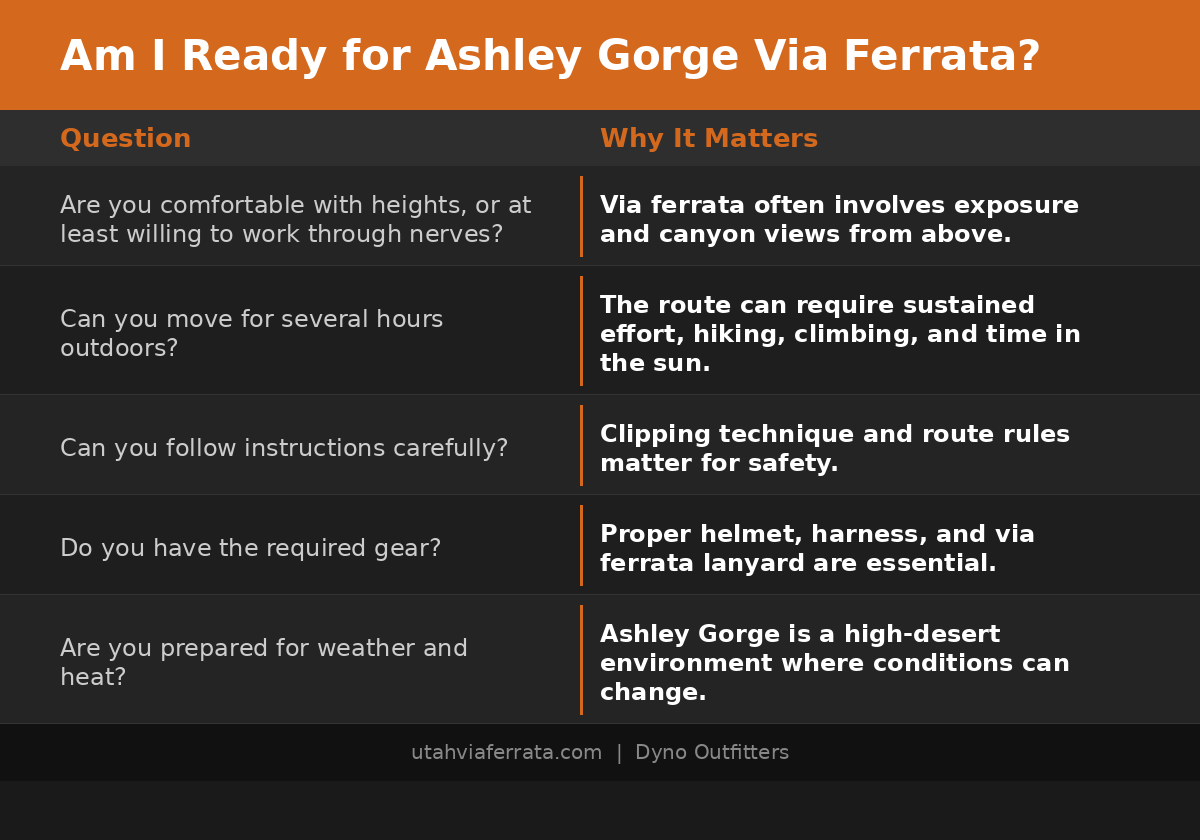
If you are unsure about any of these, that does not automatically mean you should not go. It usually means a guided trip is the better choice.
Required Gear for Via Ferrata Safety
Proper gear is one of the most important parts of via ferrata safety. The basic required system includes:
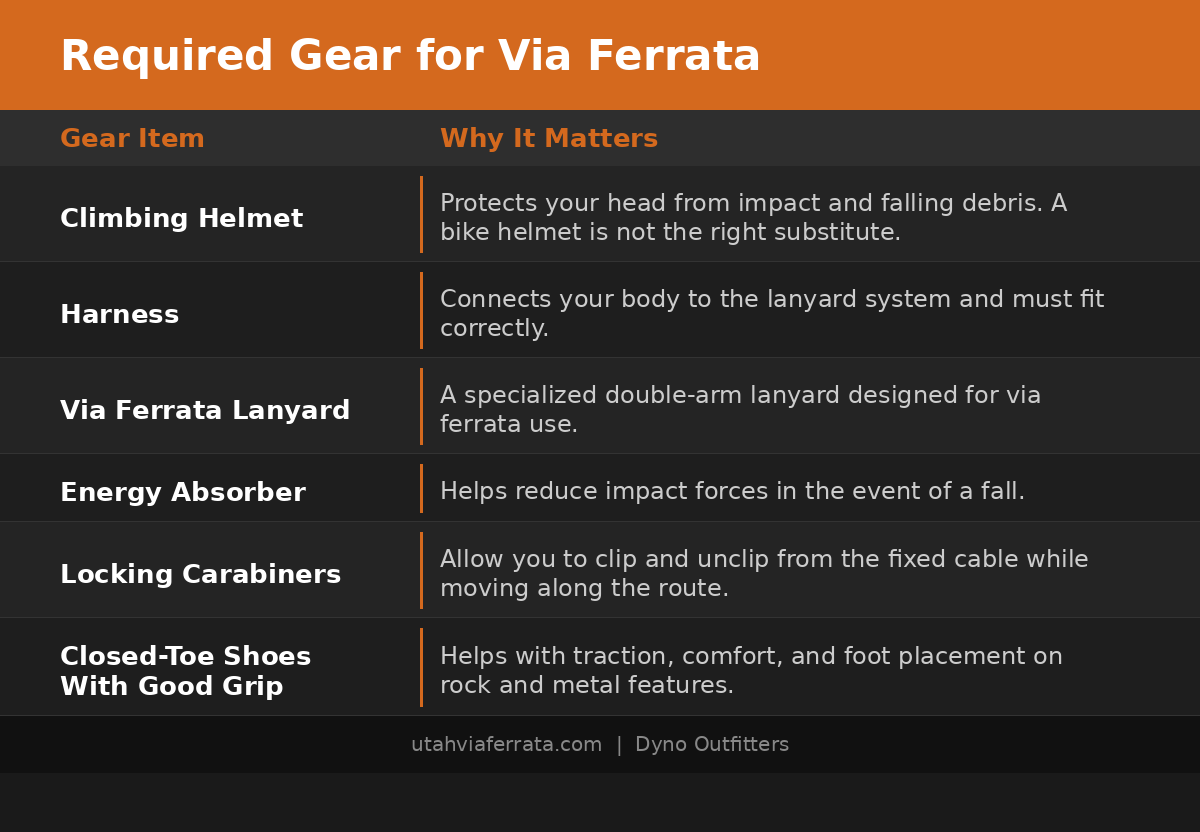
This is not a place to improvise with homemade systems, random slings, or general outdoor gear that was not designed for via ferrata use. Via ferrata falls can generate forces that are different from normal hiking slips. Certified via ferrata equipment exists for a reason.
For Ashley Gorge, climbers should use the proper required gear whether they are climbing with a guide or climbing self-guided. If you do not own the right equipment, renting from a local Vernal outfitter is the practical next step. If you are not sure how to use the gear, booking a guide is usually the better decision.
IF YOU TRY TO DO THE ASHLEY GORGE VIA FERRATA WITH INCORRECT GEAR, YOU CAN BE TURNED AWAY AND/OR BANNED FROM THE COURSE!
Get the correct gear here <
Guided vs Self-Guided: Which Is Safer for Beginners?
The Ashley Gorge Via Ferrata is a public route, which means qualified climbers may be able to experience it without a guide if they meet the requirements, understand the route, have the correct gear, and know how to use it properly.
But for beginners, guided is usually the safer and more confidence-building option.
A guided via ferrata trip can help with:
Gear fitting and inspection
Safety briefing before the climb
Clipping technique
Efficient climbing movement
Route pacing
Weather awareness
Group spacing
Coaching through exposed sections
Helping nervous climbers stay calm
Choosing the right route plan for the group
Self-guided climbing may make sense for people who already understand via ferrata systems, meet the route requirements, have the right equipment, and feel confident managing themselves and their group without outside support.
If you are asking, “Can regular people do this?” the answer is often yes. If you are asking, “Will I feel better doing this with someone who knows the route?” the answer is probably also yes.

What Makes Ashley Gorge Different for Beginners?
Ashley Gorge is not a generic climbing wall or indoor ropes course. It is an outdoor canyon experience near Vernal, Utah, with real exposure, real scenery, and real adventure. That is what makes it special, and it is also why preparation matters.
Beginners should understand that the route can include:
Fixed cables
Metal rungs
Ladders
Bridges
Cliffside traverses
Steep terrain
High-desert sun
Changing weather
Sections that may feel more exposed than expected
This is exactly why so many first-timers are drawn to it. You get to step into something that feels outside your normal life. You get to do something that feels bold, scenic, and memorable. But the route should be respected.
The best beginner experience comes when the adventure feels exciting, not confusing. That means knowing what to wear, what to bring, how long the day may take, what the gear does, and who to ask if you are unsure.
Safety Tips for First-Time Via Ferrata Climbers
Whether you go guided or self-guided, these are the habits that keep via ferrata safe.
Start early. High desert heat at Ashley Gorge can be brutal by mid-morning in summer. Dyno Outfitters can meet you as early as 5:15am for gear pickup, or even earlier (if desired) for guided trips. Earlier starts mean cooler temps, better conditions, and more time on the route without racing the heat.
Bring enough water. At least 2 liters per person, minimum. Electrolytes help. The approach hike and the climbing itself are physical, and dehydration compounds fatigue faster than most people expect.
Wear the right shoes. Approach shoes or hiking boots with grip. At a minimum, sturdy tennis shoes with good tread. Save the gym shoes for flat ground.
Never use homemade gear. At Ashley Gorge, using anything other than a certified via ferrata lanyard is a class B misdemeanor. Slings, webbing, daisy chains, and improvised systems fail on via ferrata routes. Even arborist/industrial lanyards are not designed for the type of factor 2 fall you could see on a via. This is not a gray area.
Stay clipped in. Both carabiners, clipping one at a time past each anchor, any time there is a cable (even when passing!). The moment you unclip everything to take a photo or pass someone is the moment a life-altering fall becomes possible on an otherwise ‘easy’ section of the route.
Check the weather. Via ferrata routes are exposed, making you a great target for lightning. If a storm is building, get off the route. Wet rock is dramatically more dangerous than dry rock. Plan your day so you're finishing up before afternoon storms roll in during the summer months.
Know your limits. The most common via ferrata emergency in the research data is exhaustion. Long routes at lower difficulty grades are often harder than they look on paper. Honest self-assessment before you commit to the full route saves a lot of trouble.
When Should a Beginner Book a Guide?
You should strongly consider booking a guide if:
It is your first via ferrata
You are bringing kids or teens
You are nervous about heights
You do not know how to use via ferrata gear
You do not own the required gear
You are visiting Vernal and want the easiest experience
Your group has mixed ability levels
You are not familiar with the many route options in the Gorge
You are unsure about weather, timing, or requirements
You want the experience to feel more supported and less stressful
A guide does not make the adventure less real. A guide helps make the adventure more approachable. You still climb. You still move through the canyon. You still feel the exposure, the views, and the accomplishment. You just do it with someone who knows how to help you through it.

So, Is The Via Ferrata Safe for Beginners?
Ashley Gorge via ferrata can be safe for beginners when the experience is treated with the respect it deserves. The safety system is designed to help people move through exposed terrain, but it only works when climbers use the right gear, follow the rules, understand the technique, and make good decisions.
For Ashley Gorge, beginners should think of the route as accessible adventure, not casual recreation. It is an opportunity to do something extraordinary, but that opportunity comes with responsibility.
If you are new to via ferrata, the best path is simple: learn what to expect, wear the right clothing, bring the right supplies, use certified gear, check the weather, and book a guide if you are unsure.
Use the links below to get the right gear, guides or information to be safe and make unforgettable memories.
Sources
Austrian Alpine Safety Board Registry / Mortality in Via Ferrata Emergencies in Austria from 2008 to 2018. Published in the International Journal of Environmental Research and Public Health (PMC). https://pmc.ncbi.nlm.nih.gov/articles/PMC6981439/
Safety Management of Via Ferrata Climbers in the European Alps: Epidemiology of Injuries and First Aid Knowledge of the Mountaineers. Preprints.org, August 2023. https://www.preprints.org/manuscript/202308.1706
International Climbing and Mountaineering Federation (UIAA) review on via ferrata accessibility and risk. Referenced via Outside Online, October 2025. https://www.outsideonline.com/adventure-travel/news-analysis/via-ferrata-how-safe-are-they/
Equipment, Risk Awareness and Safety-Relevant Behaviour of Via Ferrata Climbers. PubMed / Sportverletz Sportschaden, 2015. https://pubmed.ncbi.nlm.nih.gov/25919334/
Via Ferrata for Beginners: Safely Tackling Your First Iron Path. Inspired by Sports, 2026. https://www.inspiredbysports.com/en/beginner-via-ferrata-equipment-safety/
