
Via Ferrata vs Rock Climbing, What’s the Difference?
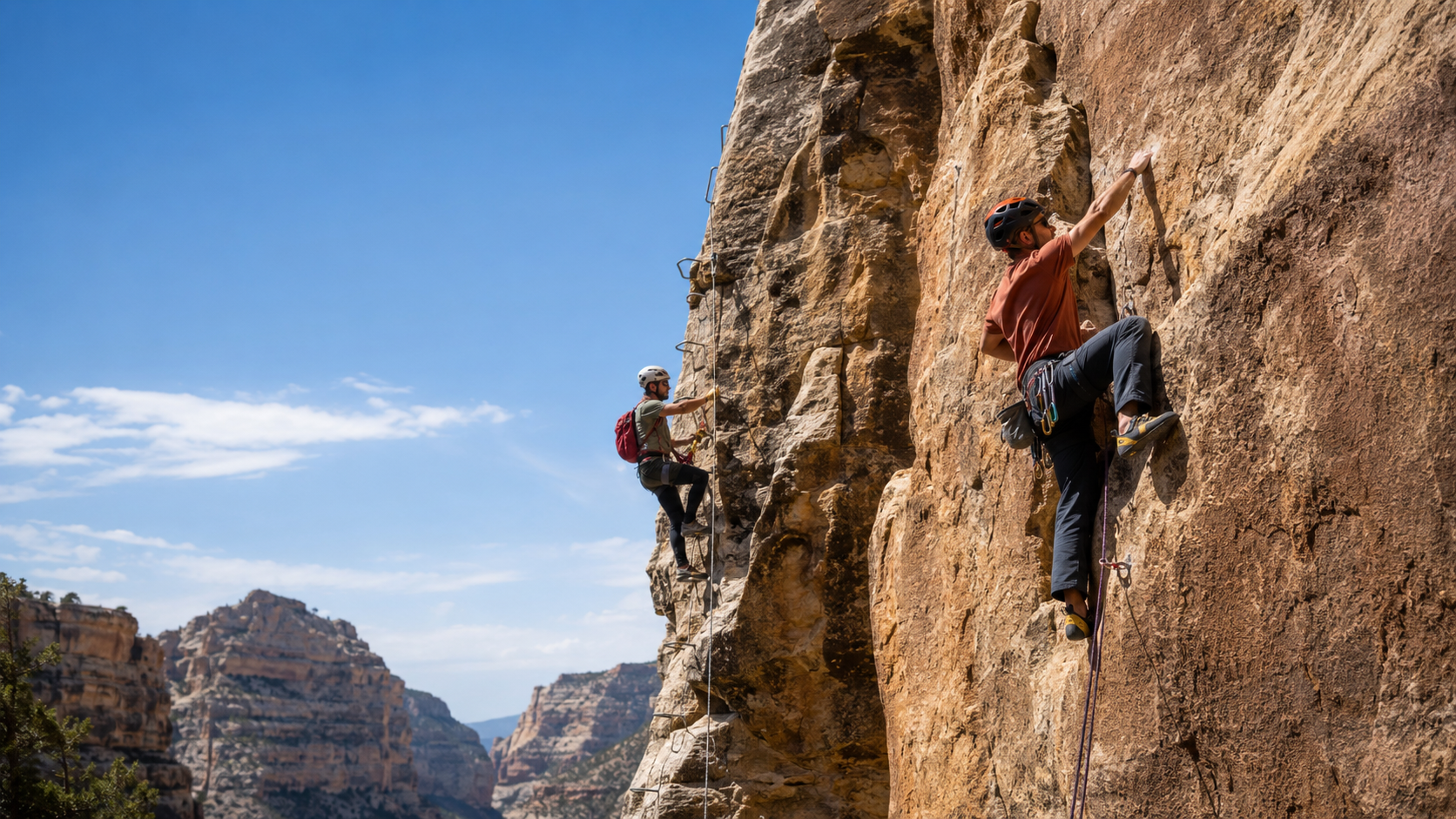
At first glance, via ferrata and rock climbing can look similar. Both happen on real rock. Both involve helmets, harnesses, exposure, heights, and moving through steep terrain. Both can create the same feeling of accomplishment when you look back and realize where you just climbed.
But they are not the same activity.
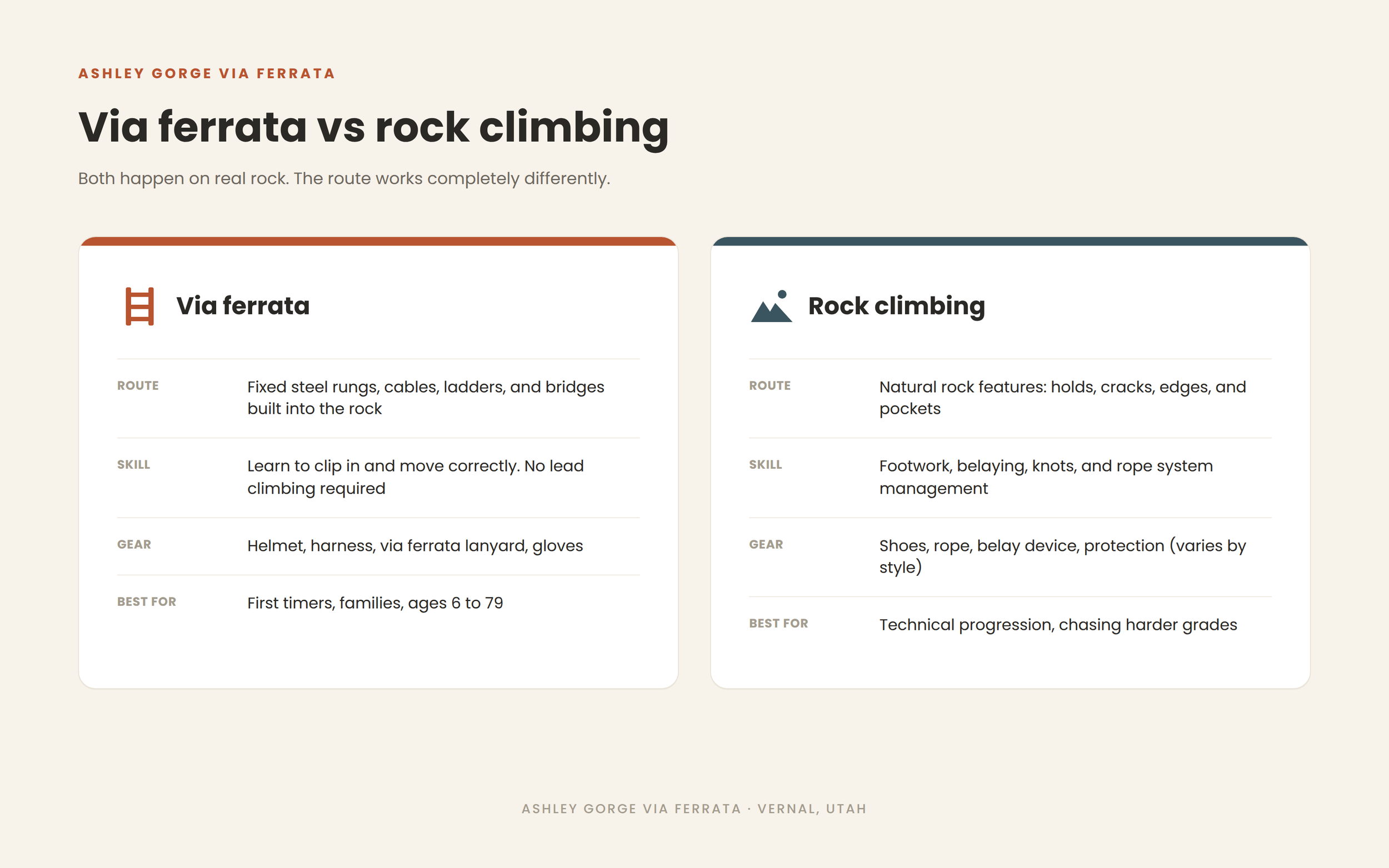
Rock climbing is about using your hands, feet, body position, technique, and rope systems to climb natural rock features. Via ferrata uses a protected route with fixed steel rungs, cables, ladders, bridges, and other built-in features to help people move through vertical terrain while staying attached to a safety cable.
That difference changes almost everything: the skill required, the gear used, the style of movement, the level of instruction needed, and who the activity is best suited for.
At Ashley Gorge Via Ferrata near Vernal, Utah, that difference is a big reason the route has become such an exciting outdoor experience. Ashley Gorge gives people access to steep canyon walls and dramatic exposure without requiring them to already be experienced rock climbers. The visitor report identifies Ashley Gorge Via Ferrata as a public via ferrata managed by Uintah County, with guided experiences provided by Dyno Outfitters.
What Is a Via Ferrata?
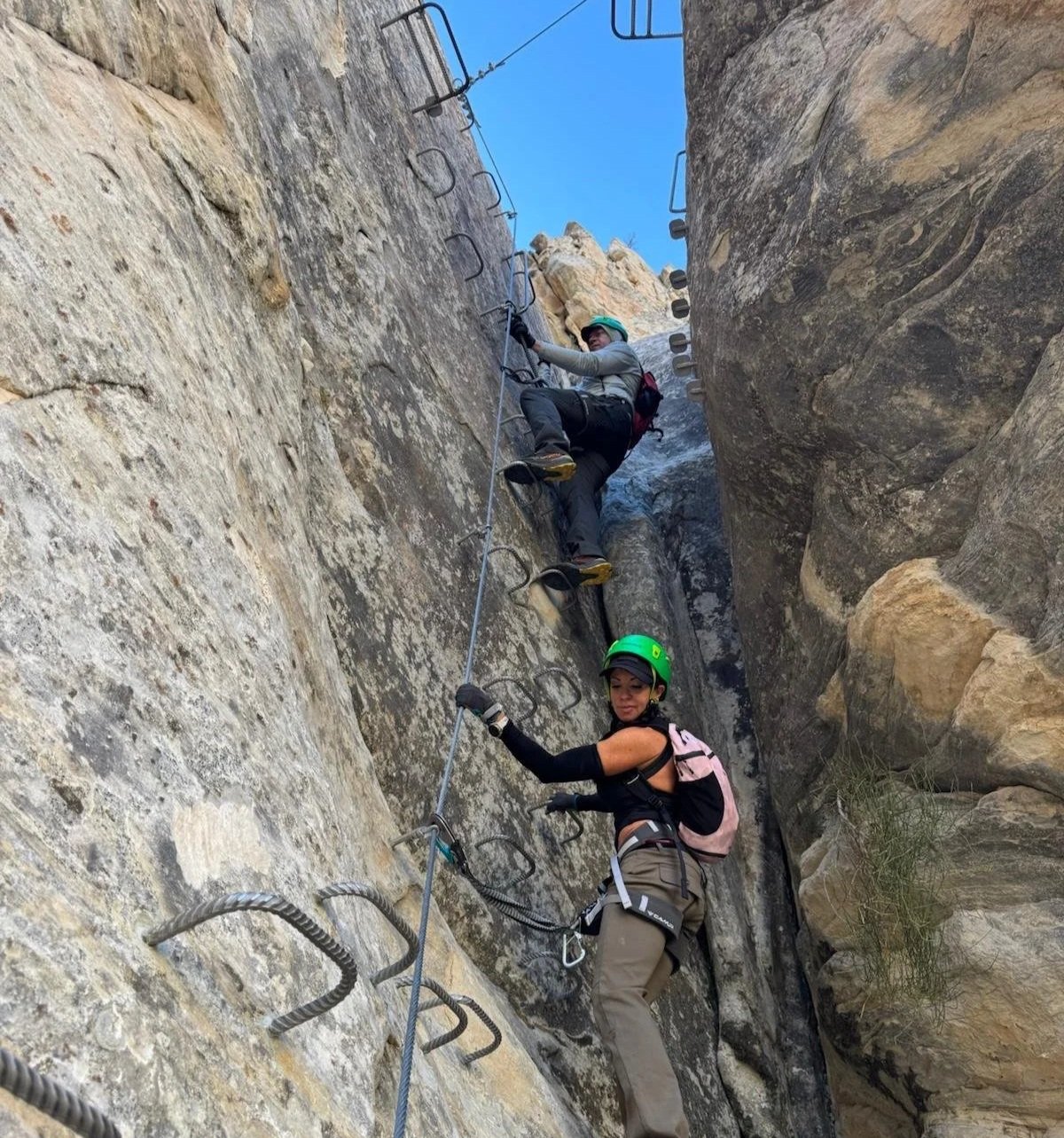
A via ferrata is a protected climbing route built into steep rock. The term comes from Italian and is commonly translated as “iron path,” which makes sense when you see one in person. Instead of relying only on natural holds in the rock, climbers use fixed steel features to move through the route.
A typical via ferrata may include steel rungs, cables, ladders, stemples, bridges, and exposed traverses. Climbers wear a harness, helmet, and via ferrata lanyard system, then clip into the steel cable as they move from section to section.
The main idea is simple: the route provides the path, and the climber follows it.
That does not mean via ferrata is easy or risk-free. You are still moving through exposed terrain. You still need the right equipment. You still need to understand how to clip correctly, move efficiently, manage fatigue, and make safe decisions. But compared to traditional rock climbing, via ferrata removes some of the biggest barriers for beginners.
You do not have to know how to lead climb.
You do not have to place protection. You do not have to build anchors. You do not have to read a natural climbing route the same way a rock climber does. Instead, you follow a fixed system designed to help people move through terrain that would otherwise be inaccessible to most visitors.
What Is Rock Climbing?
Rock climbing is a broader category with several different styles, including top-rope climbing, lead climbing, sport climbing, trad climbing, bouldering, and multi-pitch climbing. The common thread is that climbers use natural rock features to ascend.
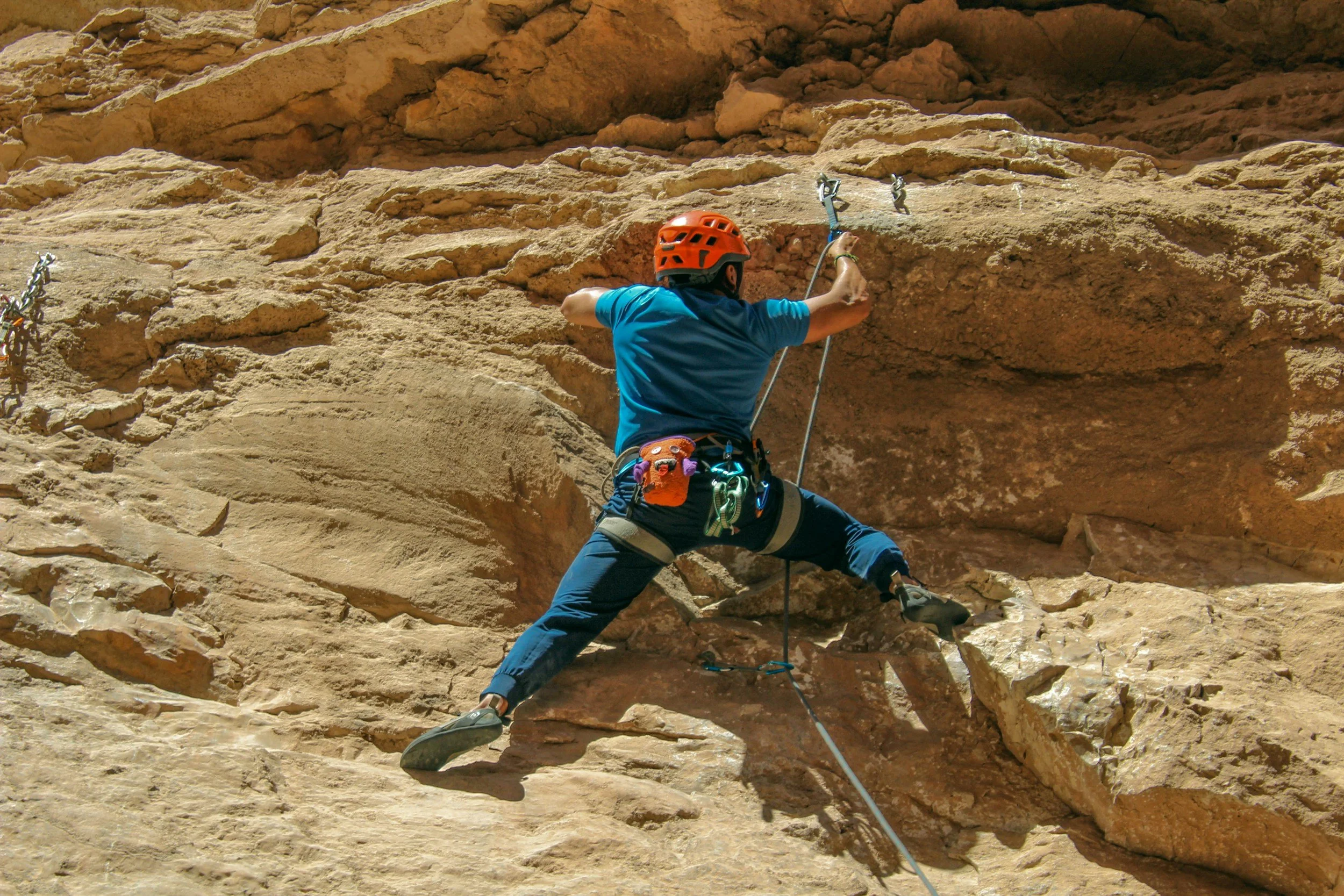
In rock climbing, the rock itself is the route. Climbers use handholds, footholds, cracks, edges, pockets, smears, body tension, balance, and technique to move upward. Depending on the style, they may also use ropes, quickdraws, cams, nuts, anchors, belay devices, crash pads, and other technical systems.
Rock climbing generally requires more technique than via ferrata. A new climber has to learn how to use their feet, shift weight, trust small holds, belay properly, communicate with a partner, tie knots, and understand basic rope systems. Even on beginner-friendly climbs, there is a learning curve.
That is part of what makes rock climbing so rewarding. It is skill-based. Progress is measurable. Climbers can improve their technique over time, try harder grades, and learn more advanced systems.
But that learning curve can also make rock climbing intimidating for someone who just wants to experience real vertical terrain for the first time. Via ferrata often serves as a better entry point for people who are curious about climbing-style adventure but are not ready to become climbers in the technical sense.
The Biggest Difference: The Route Is Built Differently
The clearest difference between via ferrata and rock climbing is how the route works.
On a via ferrata, the route is built into the rock using fixed features. You move along a known path. The steel cable gives you a continuous protection system. The rungs, ladders, and bridges give you specific places to step, grab, and move.
In rock climbing, the route is usually defined by the natural rock. Even if bolts are installed for sport climbing, the climber still has to use the rock itself to ascend. The holds are not built for you. You have to find them, use them, and move your body in a way that makes the climb possible.
That makes via ferrata feel more like an exposed adventure route, while rock climbing feels more like a technical climbing challenge.
At Ashley Gorge, that distinction matters. Visitors are not just hiking, but they are also not doing traditional rock climbing. They are moving across a fixed route that gives them access to big walls, canyon views, ladders, cables, and bridges while following a protected system.
Gear: Via Ferrata Gear vs Rock Climbing Gear
The gear overlaps in some areas, but the systems are different.
For via ferrata, the essential gear usually includes a helmet, climbing harness, via ferrata lanyard with energy absorber, gloves, proper footwear, water, and clothing appropriate for the weather. The via ferrata lanyard is especially important because it is designed for the specific forces and clipping style of via ferrata movement.
For rock climbing, gear depends heavily on the style. A top-rope climber may need a helmet, harness, climbing shoes, rope, belay device, locking carabiners, and an anchor system. A sport climber may add quickdraws. A trad climber may carry cams, nuts, slings, and more advanced protection. Boulderers may only use climbing shoes, chalk, and crash pads.
The short version: via ferrata gear is specialized around moving along a fixed cable system. Rock climbing gear is specialized around rope systems, protection, belaying, anchors, and climbing movement.
This is one reason gear rentals matter for Ashley Gorge. A standard hiking setup is not enough, and a normal climbing lanyard is not the same as a proper via ferrata lanyard. Visitors need the correct equipment before getting on the route.
Skill Level: Which One Is Better for Beginners?
For most first-time adventurers, via ferrata is more approachable than rock climbing.
That does not mean every via ferrata is beginner-friendly. Routes vary. Some are physically demanding, highly exposed, or mentally challenging. But in general, via ferrata removes many of the technical barriers that make rock climbing harder to start.
A beginner rock climber needs instruction on knots, belaying, rope management, communication, footwork, falling, lowering, and route reading. A beginner via ferrata participant still needs instruction, but the focus is usually more direct: how to wear the gear, how to clip and unclip correctly, how to move through the route, how to manage exposure, and how to stay attached to the system.
That is why a guided via ferrata trip can be such a good fit for first-timers. Instead of trying to learn a whole climbing discipline in one day, visitors can learn the specific skills needed for the route in front of them.
Ashley Gorge visitor data supports the idea that via ferrata appeals to a wide range of ages and experience levels. The report shows visitors from ages 6 to 79, with youth making up 15.2% of overall traffic. Guided visitors had even higher youth participation, with 28.8% under age 18 compared to 14.1% for self-guided visitors.
Exposure: Both Can Feel Big, But in Different Ways
Both via ferrata and rock climbing can involve heights, exposure, and moments that feel intense.
In rock climbing, exposure often comes from the difficulty of the movement and the space below you. You may be climbing a vertical face, moving above bolts, or trusting a rope system while you work through a sequence.
In via ferrata, exposure often comes from the route features themselves. You may be crossing a bridge, climbing a ladder, moving along a canyon wall, or stepping across open air while clipped into a cable.

For many people, via ferrata feels more immediately dramatic. You may not need advanced climbing technique, but you are still up high, looking down into a canyon, and moving across features that feel unforgettable.
That is part of the appeal. It delivers a big adventure feeling without requiring years of climbing experience.
Safety: Different Systems, Different Responsibilities
Neither activity should be treated casually.
Rock climbing safety depends heavily on rope systems, belaying, knots, anchors, protection, partner checks, and communication. Mistakes in any of those systems can be serious.
Via ferrata safety depends on using the correct gear, staying clipped into the cable, understanding transitions, spacing out properly, managing weather, respecting the route, and knowing when to turn around. It is more accessible, but it is still a vertical activity with real consequences.
The mistake some visitors make is thinking “public” means “simple.” Ashley Gorge is public, but it is still a via ferrata. Public access means visitors have the opportunity to climb. It does not remove the need for preparation.
That is where guided trips are valuable. A guide helps set expectations, teaches the clipping system, manages group movement, watches for fatigue, and helps people navigate the mental side of exposure.
Which Adventure Should You Choose?
Choose via ferrata if you want a big canyon adventure, are newer to climbing, want fixed route features, like the idea of bridges and ladders, or want to experience vertical terrain without learning all the systems of traditional rock climbing first.
Choose rock climbing if you want a more technical skill-based sport, enjoy problem solving with natural holds, want to learn rope systems, and are interested in progressing through climbing grades over time.
For many people, the best answer is not one or the other. Via ferrata can be the first step. It can help someone build confidence around heights, harnesses, helmets, exposure, and movement on rock. From there, some visitors may decide they want to try guided rock climbing too.
That makes Ashley Gorge a strong entry point into adventure climbing in Vernal. It gives people a memorable first experience while still leaving room to grow into more technical climbing if they want to.
Why Ashley Gorge Via Ferrata Is a Great First Vertical Adventure
Ashley Gorge Via Ferrata is exciting because it gives visitors access to a kind of terrain many people would never reach otherwise. You can move across canyon walls, climb fixed features, cross exposed sections, and experience Vernal from a completely different perspective.
The visitor data shows that the route is already attracting serious interest. From February through June 2026, Ashley Gorge recorded 4,039 total waiver entries, 3,157 unique visitors, and visitors from 23 states.

That growth is not surprising. Via ferrata sits in a unique space between hiking and rock climbing. It is more adventurous than a normal trail, more accessible than technical climbing, and memorable enough that people want to come back.
If you are curious about climbing but not ready to commit to rock climbing, Ashley Gorge Via Ferrata is one of the best ways to start. If you already climb, it offers a different kind of movement and a fun way to experience the canyon. If you are planning a family trip, group outing, or team-building experience, it gives your group a shared challenge that feels bigger than a typical outdoor activity.
Click one of the buttons below to learn more >
