Via Ferratas in the United States: Where to Climb, What They Cost, and What to Expect
Via ferratas were once closely associated with the Italian Dolomites, where networks of cables, ladders, and iron steps helped people move through steep alpine terrain. Today, you can find via ferratas throughout the United States, from sandstone canyons in Utah to alpine ridgelines in Colorado, California, Wyoming, and Alaska.
However, American via ferratas do not all operate the same way.
Some are free public routes that experienced climbers can access independently. Others are located on private property and require a paid guide. A few are available only to guests staying at a particular resort. Equipment, age requirements, route difficulty, operating seasons, and reservation policies also vary considerably from one destination to another.
This guide explains where to find via ferratas in the United States, how each experience works, and what you should know before choosing a route.
What Is a Via Ferrata?
Via ferrata means “iron way” or “iron path” in Italian. A via ferrata is a protected climbing route built with a combination of fixed steel cables, metal rungs, ladders, footholds, bridges, and natural rock features.
Participants wear a climbing harness connected to a specialized Y-shaped via ferrata lanyard. The lanyard has two arms and two carabiners, allowing the climber to remain attached to the safety cable while moving past anchor points.
Via ferrata climbing falls somewhere between hiking and technical rock climbing. You do not always need traditional climbing experience, but that does not mean every via ferrata is easy. Routes can involve sustained physical effort, vertical climbing, exposed traverses, long approaches, difficult exits, extreme heat, high elevations, and limited opportunities to turn around.
How Much Does a Via Ferrata Cost in the United States?
The cost depends largely on how the route is managed.
Free public via ferratas
Some routes are free to access, but participants must bring or rent the proper equipment. Equipment rental packages commonly cost approximately $40 to $50 per day.
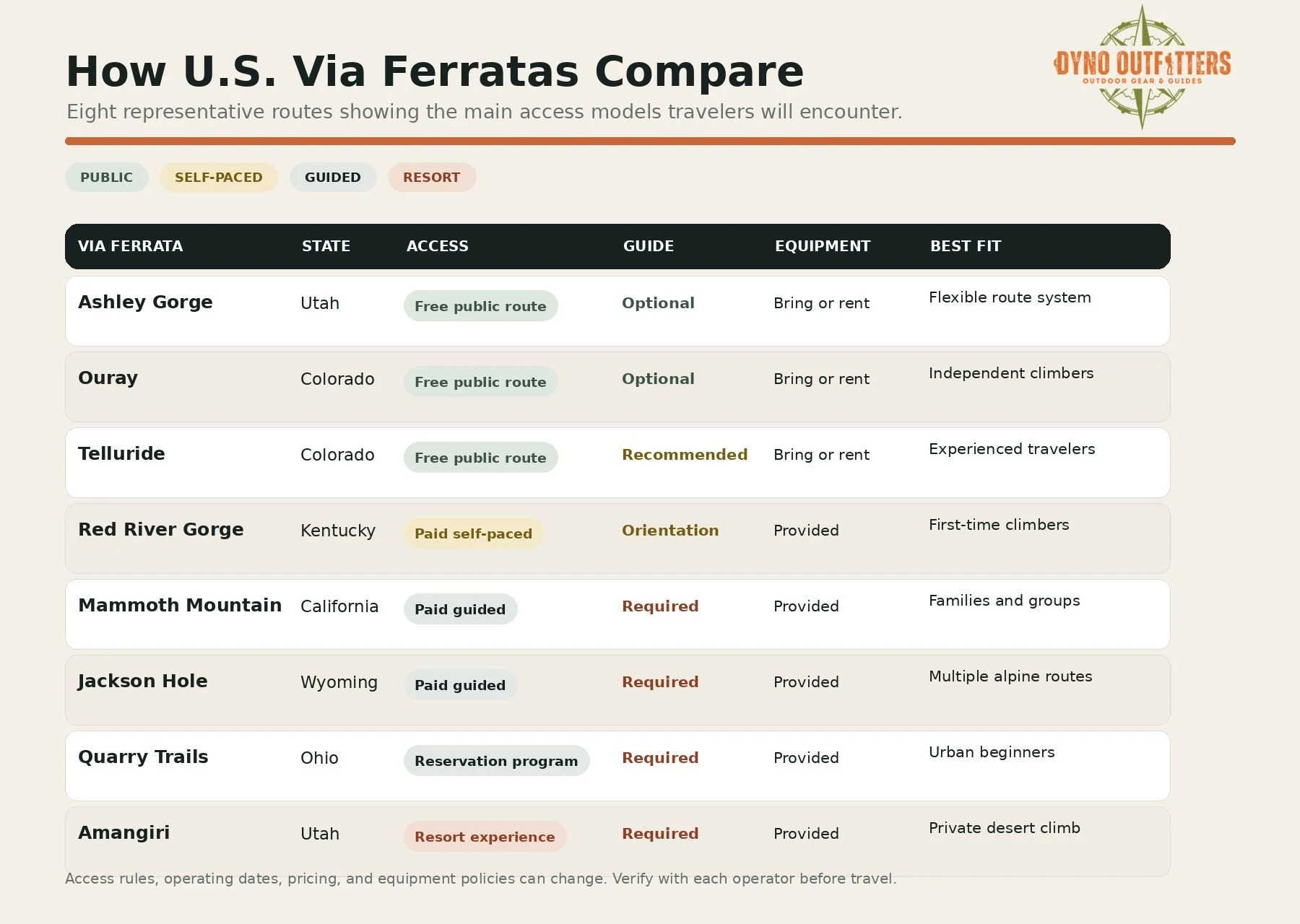
Ashley Gorge, Ouray, and Telluride are examples of public routes that qualified climbers may access independently, subject to local rules, required waivers, operating hours, closures, and equipment requirements.
Paid self-guided courses
A small number of privately operated courses allow participants to climb independently after receiving instruction and completing an orientation. These typically charge an admission fee and provide the necessary equipment.
Guided via ferrata tours
Most American via ferratas require a professional guide. Guided trips can start around $100 per person, while private groups and full-day mountain experiences may cost several hundred dollars.
At Taos Ski Valley, for example, current pricing is based on group size and includes a guide, harness, helmet, and via ferrata lanyard. Jackson Hole’s 2026 private guided experiences begin at $620 for a group of up to five people, while its full-day Corbet’s Couloir experience costs more. Prices can change by season, group size, and route.
Resort-exclusive experiences
Via ferratas at properties such as Mohonk Mountain House and Amangiri are generally available only to resort guests. The climbing activity may have an additional fee, but the true cost also includes the required stay at the property.
Public and Self-Guided Via Ferratas
1. Ashley Gorge Via Ferrata, Vernal, Utah
The Ashley Gorge Via Ferrata is located north of Vernal in northeastern Utah. Unlike many American via ferratas, Ashley Gorge is a public route rather than a private resort attraction. It is the longest public Via Ferrata in North America.
Qualified climbers may access the route without a guide if they sign the required county waiver, meet the route requirements, carry the correct certified equipment, understand how to use that equipment, and have sufficient experience to manage themselves and their group.
The route network includes steep ladders, traverses, cable bridges, canyon walls, multiple exits, and sections with very different levels of physical difficulty and exposure. Individual sections range from approximately 2B to 4C on the Fletcher/Smith via ferrata rating system.
A short visit may take a few hours, while longer combinations can occupy most of the day. Completing a large portion of the system is a sustained physical undertaking, particularly during hot weather or when climbing in a larger group.
The current public season generally runs from March 1 through November 30 during daylight hours, weather permitting. Climbers must weigh between 90 and 265 pounds, including their pack, unless they are accompanied and appropriately belayed by a professional guide. A minimum reach requirement also applies.
Dyno Outfitters in Vernal rents certified via ferrata equipment. The current full equipment package, including a lanyard, harness, and helmet, is $45. Guided half-day and full-day trips are also available for beginners, families, visitors who want help selecting a route, and climbers who fall outside the standard equipment weight range.
Access: Free public access with waiver
Guide required: No, not for properly equipped and qualified climbers
Gear rental: Available in Vernal
Best for: Visitors who want route options, public access, and the ability to choose between guided and independent climbing
2. Ouray Via Ferrata, Ouray, Colorado
The Ouray Via Ferrata follows the walls of the Uncompahgre Gorge in southwestern Colorado. It offers two primary directions and difficulty levels.
The Downstream Route is the more approachable option, although it still requires fitness, proper equipment, comfort with exposure, and the ability to manage the cable system independently. The Upstream Route is more demanding and relies more heavily on natural rock features.
Features include cable bridges, vertical climbing, narrow ledges, a helix ladder, and the approximately 75-foot Sky Ladder. The route generally takes between two and three and a half hours, depending on the selected route and the group.
Access is free, but participants must have an EN958-certified via ferrata energy-absorbing system, an approved climbing helmet, and an approved harness. The normal operating season runs from early May through the end of October. Equipment packages are available from several Ouray businesses and currently start around $45 per day.
Access: Free public route
Guide required: Not normally, but strongly recommended for inexperienced participants
Gear rental: Available in Ouray
Best for: Independent climbers who want a well-established public route
3. Telluride Via Ferrata, Telluride, Colorado
Telluride’s via ferrata is one of the best-known public routes in the United States. It traverses the cliffs above Telluride and offers dramatic views of the surrounding valley and Bridal Veil Falls.
Unlike courses built primarily around repeated vertical ladders and rungs, much of the Telluride experience involves exposed horizontal movement along the cliff. The route contains sections of hiking and scrambling between protected portions, so participants need more than the ability to clip carabiners along a continuous cable.
Public access remains free, but the Telluride Mountain Club strongly recommends hiring a local guide, particularly for first-time visitors. Route finding, weather, exposure, passing other groups, and sections without continuous protection make local knowledge valuable.
Access: Free public route
Guide required: No, but strongly recommended
Gear rental: Available through local outfitters
Best for: Experienced and properly equipped climbers comfortable with exposure and mountain travel
4. Red River Gorge Via Ferrata, Campton, Kentucky
The Red River Gorge Via Ferrata is located on private property and is operated by Southeast Mountain Guides. Opened in 2001, it is recognized as the first commercially operated via ferrata in the United States.
The approximately three-quarter-mile route follows sandstone cliffs and is divided into sections of increasing difficulty. Participants complete an orientation before entering the course, but they can then move through it at their own pace under staff supervision.
Most groups should plan for approximately four to six hours. Equipment is provided, and no previous climbing experience is required. This makes Red River Gorge one of the more accessible options for people who want independence without taking on the responsibilities of an unmanaged public route.
Access: Paid, privately operated course
Guide required: Orientation and supervision are provided, but climbing is self-paced
Gear rental: Included
Best for: First-time climbers who want freedom to move at their own pace
Guided Via Ferratas in the Western United States
5. Gold Mountain Via Ferrata, Ouray, Colorado
Gold Mountain is a private, guided via ferrata near Ouray. The route climbs through historic mining terrain at approximately 11,000 feet and includes the 273-foot Bridge of Heaven.
Trips are private and generally take four to five hours. Although it offers considerable exposure and an alpine setting, the route is designed to remain approachable for first-time participants when led by a professional guide.
Access: Private guided route
Guide required: Yes
Best for: Small groups looking for a private alpine experience
6. Mount Blue Sky Via Ferrata, Idaho Springs, Colorado
Located approximately 30 minutes west of Denver, the Mount Blue Sky Via Ferrata combines traditional via ferrata features with suspended bridges, rappelling, free-fall elements, and zip lines.
The half-day guided experience currently starts at $129. Participants must be at least 12 years old and meet the operator’s weight requirements. Harnesses, helmets, and gloves are provided.
Access: Paid guided course
Guide required: Yes
Best for: Visitors staying near Denver who want a half-day adventure
7. Granite Via Ferrata, Buena Vista, Colorado
The Granite Via Ferrata is operated by the same company as the Mount Blue Sky course. It traverses granite cliffs above the Arkansas River Valley, with views toward the Collegiate Peaks.
This is a guided adventure course rather than an independently accessible mountain route. It blends cliffside climbing with constructed aerial features and is generally marketed toward participants seeking a physically active, high-adrenaline experience.
Access: Paid guided course
Guide required: Yes
Best for: Visitors combining a via ferrata with rafting or other Buena Vista activities
8. Royal Gorge Via Ferrata, Cañon City, Colorado
The Royal Gorge Via Ferrata takes participants onto the granite walls of the Royal Gorge above the Arkansas River.
Multiple trip lengths are available, ranging from shorter introductions to experiences lasting much of the day. All climbs are professionally guided and are offered as an add-on to admission at Royal Gorge Bridge and Park.
Access: Paid attraction
Guide required: Yes
Best for: Families and travelers already visiting the Royal Gorge area
9. Taos Ski Valley Via Ferrata, New Mexico
The Taos Via Ferrata begins high in the Sangre de Cristo Mountains at approximately 11,500 feet. Features include a 100-foot sky bridge, aerial cable crossings, vertical climbing, and views toward Wheeler Peak Wilderness.
All trips are guided, and technical equipment is included. The high elevation adds a significant physical factor even for visitors who are comfortable climbing ladders or moving across exposed terrain. The 2026 summer operation began June 27, subject to mountain conditions.
Access: Paid guided course
Guide required: Yes
Best for: Visitors comfortable with high elevation and alpine weather
10. Tahoe Via Ferrata, Olympic Valley, California
The Tahoe Via Ferrata climbs the Tram Face above the base of Palisades Tahoe. Participants can book two-hour, three-hour, four-hour, and private tours on routes designed for different ability levels.
All trips are guided, and the operator provides the harness, helmet, and specialized lanyard. The route is a good introduction for participants who want instruction and a controlled progression into more exposed movement.
Access: Paid guided course
Guide required: Yes
Best for: First-time and intermediate climbers visiting Lake Tahoe
11. Mammoth Mountain Via Ferrata, Mammoth Lakes, California
Mammoth Mountain offers six routes that progress from introductory terrain to more challenging climbing. The routes are located near the middle station of the Panorama Gondola, where participants begin with an orientation and practice session.
For 2026, Mammoth offers 90-minute group tours and three-hour private tours. The operating season runs from June 19 through September 7, subject to weather and mountain conditions.
Access: Paid guided course
Guide required: Yes
Best for: Families and groups looking for several difficulty options in one area
12. Jackson Hole Via Ferrata, Teton Village, Wyoming
Jackson Hole Mountain Resort operates one of the largest guided via ferrata networks in North America. Its 2026 system includes 20 routes ranging from introductory climbs to strenuous alpine terrain.
The Casper Bowl routes accommodate a wide range of abilities. Newer routes near Corbet’s Couloir involve a more demanding approach, sustained climbing, alpine exposure, and large suspension bridges. All routes are above 9,000 feet.
Half-day trips last approximately three and a half hours, while full-day experiences last around six hours. The Corbet’s routes require a full-day booking and are available only to participants who meet the age, weight, fitness, and guide-assessment requirements.
Access: Paid guided course
Guide required: Yes
Best for: Groups that want multiple route choices, alpine terrain, and a private guide
Guided Via Ferratas in the Eastern United States
13. NROCKS Via Ferrata, Circleville, West Virginia
The NROCKS Via Ferrata crosses two rock fins in West Virginia’s North Fork Valley. The professionally guided route covers approximately one mile, gains more than 1,000 feet of elevation, and includes a suspension bridge approximately 200 feet long and 150 feet above the ground.
Most trips take between three and a half and five hours. The route is known for combining significant exposure with an approachable guided format.
Access: Paid guided course
Guide required: Yes
Best for: East Coast adventurers looking for a substantial half-day climb
14. Quarry Trails Via Ferrata, Columbus, Ohio
Quarry Trails Metro Park is home to one of the most unusual via ferratas in the country. The route is located in a former limestone quarry only a few miles from downtown Columbus.
The 1,040-foot course includes fixed cables, ladders, aerial walkways, a steel staircase, and a 90-foot suspension bridge positioned 105 feet above a pond. It generally takes about 90 minutes to complete.
Programs are guided and available only through advance registration. Participants must be at least 14 years old, at least five feet tall, and weigh between 88 and 265 pounds.
Access: Free guided program with reservation
Guide required: Yes
Best for: Beginners and urban adventurers near Columbus
15. Ausable Chasm Adventure Trail, New York
The Ausable Chasm Adventure Trail follows sandstone walls above the Ausable River in the Adirondacks. Participants cross several cable bridges, climb a cargo net, and move along exposed edges in areas that cannot be reached from the standard walking trails.
The route is fully guided and included as part of the property’s Premium Adventure Tour. Reservations are not normally accepted, so availability may depend on arrival time and daily capacity.
Access: Paid guided attraction
Guide required: Yes
Best for: Families and visitors exploring the Adirondacks
16. Mohonk Mountain House Via Ferrata, New Paltz, New York
The Mohonk Mountain House Via Ferrata climbs the quartz conglomerate cliffs of the Shawangunk Mountains. Features include cable traverses, aerial bridges, and sky ladders.
The experience is available seasonally and only to guests who book a stay at Mohonk Mountain House. Participants must be at least 13 years old, and all climbs are professionally guided.
Access: Resort guests only
Guide required: Yes
Best for: Travelers seeking a guided climbing experience as part of a resort stay
Exclusive and Destination Via Ferratas
17. Above Zion Via Ferrata, Virgin, Utah
The Above Zion Via Ferrata is a privately operated guided experience near Zion National Park. The route follows exposed ledges and high desert cliffs with views across the Zion area.
It is designed as an approachable introduction to via ferrata climbing, but participants still need sufficient fitness to hike and climb ladders for several hours. Access is available only through Utah Adventure Center’s guided trips.
Access: Private guided route
Guide required: Yes
Best for: Zion visitors who want an alternative to crowded park trails
18. Amangiri Via Ferratas, Canyon Point, Utah
Amangiri operates an extensive collection of private via ferrata routes across its sandstone property in southern Utah. Options range from introductory family experiences to highly exposed climbs.
The network includes routes such as Hoodoo, Vertigo, Voodoo, and Cave Peak. Some routes connect with the Cave Peak Stairway, a 120-step suspension structure rising approximately 400 feet above the desert floor.
All routes are led by Amangiri guides and are primarily available to resort guests. Current experience materials list three-hour private via ferrata trips for groups of up to four people, with pricing around $1,000 depending on the selected route and added activities.
Access: Resort guests
Guide required: Yes
Best for: Luxury travelers seeking a private desert climbing experience
19. Tordrillo Mountain Lodge Via Ferrata, Alaska
Alaska’s only via ferrata is located in the remote Tordrillo Mountains and is accessible by helicopter from Tordrillo Mountain Lodge.
The route begins approximately 4,000 feet above sea level and includes 1,200 feet of cable, suspended bridges, and approximately 900 vertical feet of climbing. Participants climb above the Triumvirate Glacier before being collected by helicopter at the top.
No previous climbing experience is required, and the lodge provides guides and technical equipment. The via ferrata is part of a larger luxury wilderness stay rather than a standalone walk-up activity.
Access: Lodge guests and package participants
Guide required: Yes
Best for: Travelers looking for a remote, helicopter-accessed mountain experience
Which Via Ferrata Is Best for Beginners?
The best beginner route is not necessarily the route with the fewest vertical feet. A first-time participant should also consider exposure, length, elevation, heat, route-finding requirements, exit options, and whether professional instruction is available.
Guided courses at Quarry Trails, Tahoe, Mammoth Mountain, Mount Blue Sky, and Jackson Hole offer structured introductions and equipment.
Ashley Gorge can also be an excellent first experience when completed with a professional guide. Its multiple sections and exits allow a guide to adjust the day according to the participant’s fitness, comfort with heights, and progress.
Independent public routes are generally better suited to people who already know how to use a via ferrata lanyard and can evaluate terrain, weather, equipment, and group safety without assistance.
Do You Need a Guide for a Via Ferrata?
Most via ferratas in the United States require a guide because they are privately operated attractions or resort activities.
A small number of public routes allow independent climbing. However, permission to climb without a guide should not be confused with readiness to climb without one.
Consider hiring a guide when:
It is your first via ferrata.
You do not know how to use a via ferrata lanyard.
You are unfamiliar with the route.
Someone in your group is uncomfortable with heights.
Your group includes children or participants outside standard lanyard weight requirements.
You want help selecting appropriate sections.
You are uncertain about weather, physical difficulty, or exit options.
You would feel more comfortable focusing on the experience instead of managing the group.
A guide provides more than equipment. A capable guide helps manage pacing, route selection, clipping technique, exposure, fatigue, group spacing, emergency decisions, and the dozens of small details that can determine whether the day feels exciting or overwhelming.
What Gear Do You Need for a Via Ferrata?
The required technical equipment generally includes:
A certified climbing helmet
A properly fitted climbing harness
An EN958-certified energy-absorbing via ferrata lanyard
Secure, closed-toe footwear with good traction
A standard pair of climbing slings or improvised tethers is not a substitute for a certified via ferrata lanyard.
Depending on the destination, you may also need gloves, water, food, sunscreen, sunglasses, a small backpack, warm layers, rain protection, and a waste bag.
Guided operators normally provide technical equipment. Public routes require you to bring or rent the proper gear yourself.
Choosing the Right Via Ferrata
Before choosing a route, ask five questions:
Is it public, privately operated, or restricted to resort guests?
Is a guide required?
Does the route offer an appropriate difficulty and duration?
Do all participants meet the age, reach, and weight requirements?
Is technical equipment provided, available to rent, or something you must supply?
The right via ferrata should challenge you without placing you in terrain that exceeds your experience, fitness, or ability to make safe decisions.
Experience Ashley Gorge Via Ferrata in Vernal, Utah
For visitors who want more than a short constructed course, Ashley Gorge offers an extensive canyon route system with options for different abilities and time commitments.
Experienced participants can rent certified equipment in Vernal and climb independently after meeting the public route requirements. First-time visitors can book a guided trip and learn the correct techniques while exploring sections selected for their comfort level and goals.
Dyno Outfitters offers guided half-day and full-day trips, certified equipment rentals, route information, and local guidance for the Ashley Gorge Via Ferrata.
Whether you want your first experience on an iron path or an all-day journey through the gorge, proper preparation is the place to begin.
